



By Dr Lucy Goodman and Dr Christopher Schulz
We have seen renewed pledges of investment in renewable energy, including hydropower, as well as nuclear energy at COP28 and COP29, although progress varies considerably, as per International Energy Agency reports. In the lead-up to COP30, calls to accelerate the energy transition and honour these commitments are intensifying. In this context, Lucy Goodman and Christopher Schulz highlight surprising parallels between large-scale hydropower and nuclear energy infrastructure, sounding a note of caution about their planned expansion in many countries around the world.
COP30 is upon us, and a growing chorus of voices is reminding participating countries of their pledges to expand renewable energy. The International Energy Agency (IEA) had sounded the alarm bells quite a while ago. Its 2024 progress report had shown that the world is not on track to meet pledges made at COP28 of tripling renewable capacity this decade. This would require major investments in solar and wind energy, and hydropower; the IEA lamented, in particular, that hydropower was being overlooked as a potential solution towards decarbonising energy systems in strategic plans made by countries around the world.
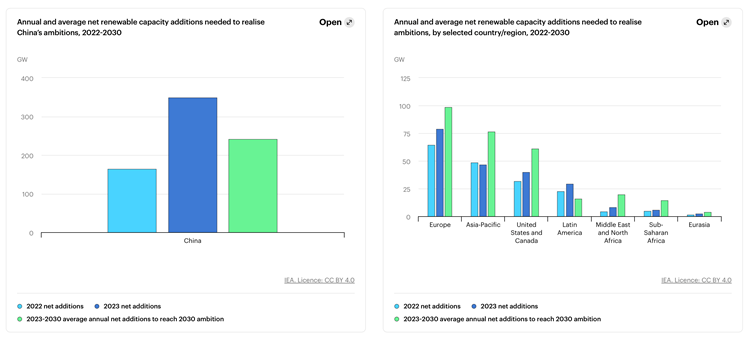
That said, there are huge differences between countries. China installed 350 GW of new renewable energy capacity in 2023, or nearly half the global total, while the European Union, the US, and India are lagging behind (see Figure 1 below). The IEA report, like the COP28 declarations, had triggered renewed interest in ways of restructuring electricity grids around fossil-free power – COP30 will be another opportunity to put pressure on countries to follow through with commitments made.
Alongside the pledge to increase investment in renewable energy, a minority of countries also promised to expand their nuclear power capacity; this group grew further to a total of 31 at the latest COP29, including major industries such as the UK, France, Japan, Turkey, Nigeria, and the US.
The phasing out of coal- and gas-fired power stations requires a search for alternative sources that can stabilise the energy grid. The IEA has put the spotlight on wind and solar, but these come with the caveat of being intermittent sources of renewable energy. So if governments are serious about decarbonising the grid, they need to find ways to ramp up supply for peak energy demand, which is usually in the mornings and evenings, when the sun may not shine or the wind might not blow. The only two options to produce energy on demand which are tested at scale are nuclear energy and hydroelectric dams, which means they are likely to increase in the energy mix going forward (another option to stabilise energy grids is to temporarily store surplus energy via pumped-storage hydropower or large-scale battery plants).
While policy-makers and the wider public are generally aware of the risks of nuclear power, they often tend to think of hydropower alongside wind and solar as one among a series of comparatively uncontroversial renewable energy sources, with, at most, localised impacts. Here we outline five reasons why large-scale hydropower and nuclear energy have more in common than commonly assumed, and what this means for the energy transition away from fossil fuels.
Risk of failure with profound consequences
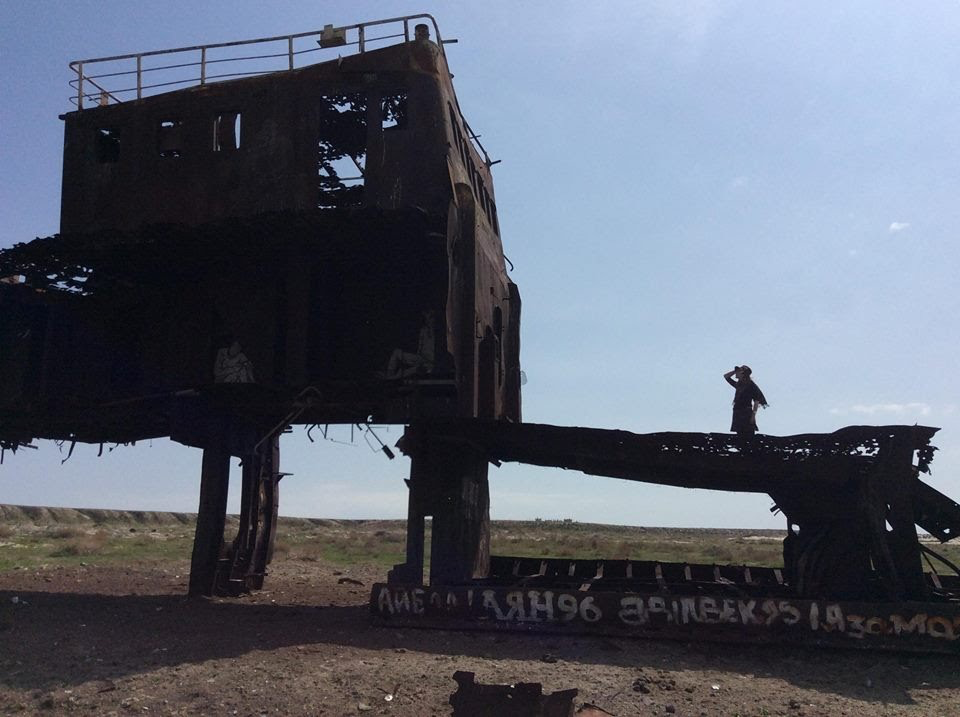
Both nuclear energy and hydropower involve managing complex infrastructure that has a low probability of high-impact failure with widespread consequences. There is high public consciousness of the nuclear accidents at Chernobyl and Fukushima, which have garnered significant attention and influenced public opinion, causing some countries to shut down their nuclear plants.
However, the overwhelming number of energy-related deaths have been from hydropower installations, which made up 94% of energy-related fatalities between 1907 and 2009. The vast majority of these can be attributed to the Banqiao dam failure in China in 1975, which drowned 26,000 people, and as many as 230,000 died from resultant famine and disease – this is a catastrophe orders of magnitude larger than any single incident from nuclear energy. The recent dam collapse in Libya, claiming the lives of more than 10,000 people, is a reminder that similar catastrophes are an enduring risk from large dams. This comparison suggests that there is a mismatch between the generally perceived and actual severity of impacts of the failure of hydropower dams vs. that of nuclear power plants.
But even where they don’t fail, the impacts of large dams can be profound; in the year 2000, the World Commission on Dams estimated that the construction of large dams had displaced 40 to 80 million people globally, a number that would have increased significantly since; not to mention their disruptive impacts on aquatic ecosystems, natural flood regimes, migratory fish and fisheries, cultural heritage sites, etc, often disproportionately affecting marginalised, rural, and indigenous communities.
Cost overruns, expensive installations, and high end-of-lifespan costs
Both nuclear and large hydropower projects are notorious for delays, cost overruns, and high installation expenses. Construction delays frequently plague hydroelectric dam projects, contributing to substantial cost overruns, which, in turn, escalate installation costs. For hydropower and nuclear, the upfront costs form most of the subsequent electricity price. Unlike wind turbines and solar panels, hydropower and nuclear energy require complex and large infrastructure that is expensive to build – once there, the costs for operation and maintenance are much more moderate in comparison.
Another commonality is that costs for decommissioning and waste management are not sufficiently factored into decision-making; nuclear energy stations take decades until fully dismantled, not to mention that nuclear waste may need to be stored safely for a period of up to 1 million years. Also, the life span of large dams is not infinite, varying widely on a case-by-case basis. But in any case, due to sediments and potentially toxic materials accumulating in dam reservoirs, their usefulness goes down over time, while costs for rehabilitation and/or removal go up.
Passionate protest and coordinated opposition at national and international scales
Opponents of both nuclear and hydropower often face accusations of narrow self-interest or being impediments to progress, when these two technologies represent the pinnacle of human ingenuity each in their own ways. Local opposition to large dams or nuclear power plants is often dismissed as not considering the greater good, which oversimplifies genuine concerns and divides communities. What makes these protests different to localised Not In My BackYard (“NIMBY”) objections is the immediate threat to life they present. While opposition to newly proposed wind or solar farms is common, they rarely stem from a general opposition to these technologies or a concern about threats to life.
Conversely, the anti-nuclear and anti-dam movements have seen considerable levels of coordination at national and international scales. For the case of dams, transnational anti-dam movements were even involved in the creation of a ‘World Commission on Dams’ (1998-2000), tasked with investigating ways to overcome conflict between supporters and opponents of large (hydropower) dams, with initial support from the World Bank – a remarkable achievement, yet also difficult mandate for those who felt that dams no longer had a place in development. While this Commission (and its final report, which validated many criticisms of the anti-dam side, despite also highlighting their benefits) was seen as a major global win for activists, interest in large dams ultimately persisted, especially in Asia, Africa, Latin America, and the Balkans.
Public opposition against nuclear energy has a very long history, with concerns linked not only to environmental and health risks, but also, its association with nuclear weapons (e.g., in Scotland). Anti-nuclear activists celebrated their perhaps biggest success in Germany, which has chosen to phase out its nuclear energy industry in response to the 2016 Fukushima disaster.
National Security Risks and Transboundary Conflict
Concerns about the security of dams being targeted during conflicts echo similar worries about the vulnerability of nuclear power stations. 2023 marked the 80th anniversary of “Operation Chastise”, when the allies bombed several dams in Germany, which killed over a thousand civilians and prisoners of war. In June 2023, the attack on the Ukrainian Kakhovka hydropower plant killed at least 50 people, many of whom were the vulnerable and elderly unable to escape the war, while others still suffer from health impacts one year later. In 2022, also in Ukraine, Russia has occupied nuclear power stations, at risk of nuclear fall-out and with international condemnation. Not all attacks need be so direct; in 2019, an Indian nuclear power plant resisted/withstood a cyberattack, which would have had serious consequences had it been successful. Although wind and solar energy infrastructure can be of strategic importance, too, they do not make for similarly impactful targets during times of armed conflict. In particular, the immediacy with which the destruction of dams and nuclear plants can harm large numbers of people sets them apart.
Large dams can also be implicated in conflict where they are operating normally; Ethiopia’s recently inaugurated Grand Ethiopian Renaissance Dam (GERD) has long been the source of diplomatic tension with downstream neighbours, especially, Egypt; there is widespread fear over the strategic control it gives Ethiopia over its neighbours’ water supply, given the singular importance the Nile River has in this arid region. Likewise, nuclear power stations can cause transboundary conflict. Austria was long opposed to the Czech Temelin nuclear plant, which eventually opened in the year 2000 near its border; this conflict was only resolved in the context of Czechia’s 2004 accession to the EU, which gave Austria some negotiating power. A more common scenario is that neighbouring countries don’t get a veto in the construction of nuclear power infrastructure near their borders.
Do they really displace fossil fuels?
Both nuclear and hydropower have been positioned as key players in the energy transition. The IEA emphasizes the need for a blend of solar PV, wind, nuclear power, and hydropower to achieve clean electrification and combat climate change. While these alternatives hold promise in reducing carbon emissions, the challenge lies in ensuring they displace fossil fuels rather than merely meeting escalating energy demands. To this day, evidence that increasing renewables decreases fossil fuels consumption is rare. Transitioning would mean that renewables are going to be adopted at scale, and coal-fired power stations are decommissioned. Expanding nuclear or hydropower infrastructure (or any other renewable energy) will only help mitigate climate change if demand does not grow more strongly, which seems unlikely, not least in the context of the current boom in energy-hungry AI data centres or the global transition to electric cars.
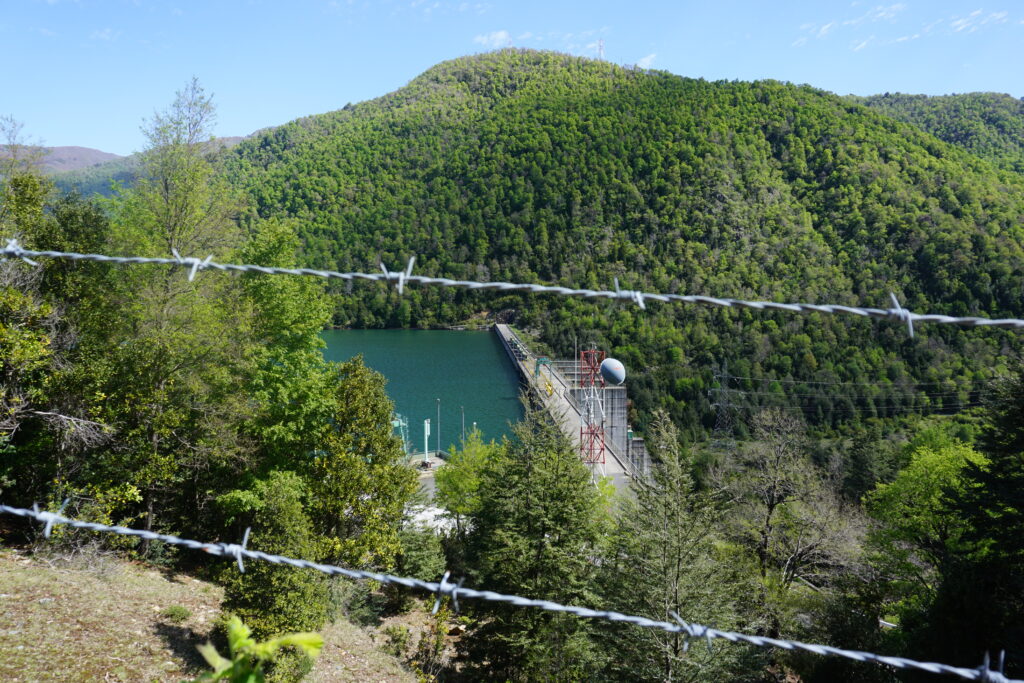
Of course, we acknowledge the differences between nuclear and large-scale hydropower energy. While hydropower dam decommissioning is challenging and will impact the next generations, nuclear waste management needs a plan which will span thousands of generations. Miniaturising hydropower reduces its risks, whereas miniature nuclear reactors, for example, those onboard submarines, still present significant hazards. Hydropower can be destructive but has not been weaponised in the way that nuclear has, and as a result does not have any international treaties governing its use (although the World Commission on Dams did try).
Drawing parallels between the debates around nuclear and hydropower energy sources offers invaluable insights. For example, understanding how public perception and decisions are influenced by incidents like Fukushima can guide us in shaping hydropower policies, as an energy source which also suffers from disasters. Further, if hydropower risk mitigation is the goal, insights from the nuclear debate are that project developers must take liability for failures and impacts, and that these should be insurable to increase public confidence.
In conclusion, while nuclear energy and hydropower possess differences, acknowledging their shared characteristics offers a fresh perspective in formulating energy transition policies. Recognising the shared gravity of risks, their high costs and challenging construction, the scales of opposition to them, and their uncertain potential to displace fossil fuels, could help decision-makers appreciate the concerns which surround both hydropower and nuclear energy. Ultimately, caution is warranted amid calls for speedy investment and expansion of these technologies, however urgent the transition away from fossil fuels may make this appear.