



CEE Artist-in-Residence Alumna Rebecca Sharp
Working with tarot, poetry, individual and group participation, Good Till The Close (GTC) is a ‘fortune-telling’, poem-generating game with inbuilt obsolescence; taking its name from the stock market term for an order given to a futures broker that stays live until fulfilled, or until the close of the market, whichever is sooner. The design of the workshop draws links between financial investment and forecasting, and the speculative, interrogative practice of tarot card reading.
I first designed GTC while I was Artist in Residence with the CEE (2022-24), as a collaboration with Elodie Laügt (Centre for Poetic Innovation, School of Modern Languages, St Andrews). We co-presented it for EE2023 Financing the Future, which explored ‘visions of and expectations for the future’, ‘relations of obligation and indebtedness’, and addressed the question ‘When should we prioritise investing in the distant future rather than focussing on the present?’.
Playing with ideas of currency, the game invites you to interact with tarot cards within a guided process – I also read and study tarot as an endlessly useful tool for reflection and questioning – designed to explore present action and future speculation; individual and collective agency; the expression of simultaneous seen and unseen narratives; the visualisation and handling of time, and various forms of transaction.
Through the workshop, we create a collective tarot reading (in fact, two), and a collective poem. My own poem ‘Good Till the Close’ (in Long Field Loop, 2024) describes the mechanism of the game and reads like a set of instructions:
Good Till The Close
The game must end.
This we know.
So, what
now?
Two tables in a room.
One holds a deck of 78 tarot cards, laid out with faces-down.
The other is empty, for now.
The players wait.
A bell rings. The floor is open, trading begins.
The first player chooses three cards from the table unseen,
then places them face-up on the second table.
The dealer briefly assesses the value of the cards.
The player is told they must choose:
- one card to keep on the table before them, to invest in a shared future vision
- one to return face-down to the deck, perhaps to be chosen again
- and one to reject, remove from game altogether
(the discarded pile becomes the shadow reading).
The sequence repeats, with players taking turns until otherwise instructed
or the deck is depleted,
whichever comes first.
Infrastructures of Energy: EE2026
In addition to running the game as the poem describes, participants are invited to choose a single word for each of their three cards. Together these words create a communal list-poem, a creative document of the day’s shared endeavour.
Below are the results of GTC at EE2026:
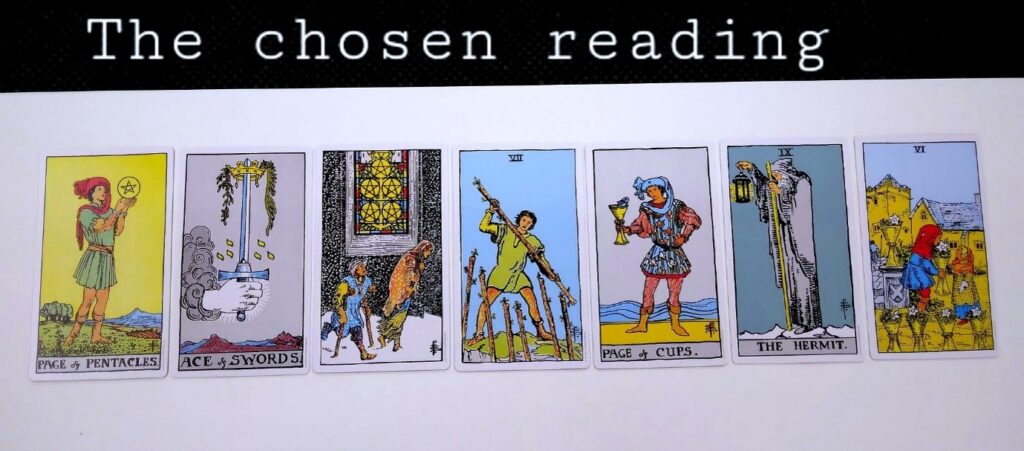
The chosen reading – or, what we want:
These are the cards that were chosen by each participant in turn, to be kept on the table and offered towards a vision for a shared future: Page of Pentacles, Ace of Swords, Five of Pentacles, Seven of Wands, Page of Cups, The Hermit, Six of Cups.
Stringing this into a narrative sequence, it could say:
We are planting a seed (Page of Pentacles), with a clear intention of what we want to achieve (Ace of Swords). However, all is not so clear and straight forward (Five of Pentacles) – as some are still left out in the cold, excluded or unable to join conversations or access resources. Thinking of infrastructures, is the scenario into which we’re bringing our Ace of Swords ready, willing or able to accept what’s being presented? We’ve been engaged in this dynamic for some time (Seven of Wands) – managing, at times it may feel like battling, various energies and inputs, however well-intentioned they may be (and some may not be – we can’t see, we can only react). Although we may be capable of holding our ground, and remain invested in the project at hand, it’s tiring and unsustainable. This can lead to rigidity, burnout and defensiveness. How to better direct this energy (and protect our own)? We might disengage for a moment, step back – to replenish, be curious and creative to find a more dynamic approach (Page of Cups). Ask different questions, get playful, find some ease. Doing this might require a longer period of stillness or retreat (Hermit). There might be a deeper story running in the background, maybe from the past (personal and / or collective) – which, once safely acknowledged and given care and attention (Six of Cups), could finally clear the way for that Page of Pentacles and Ace of Swords to be more effective in their mission.
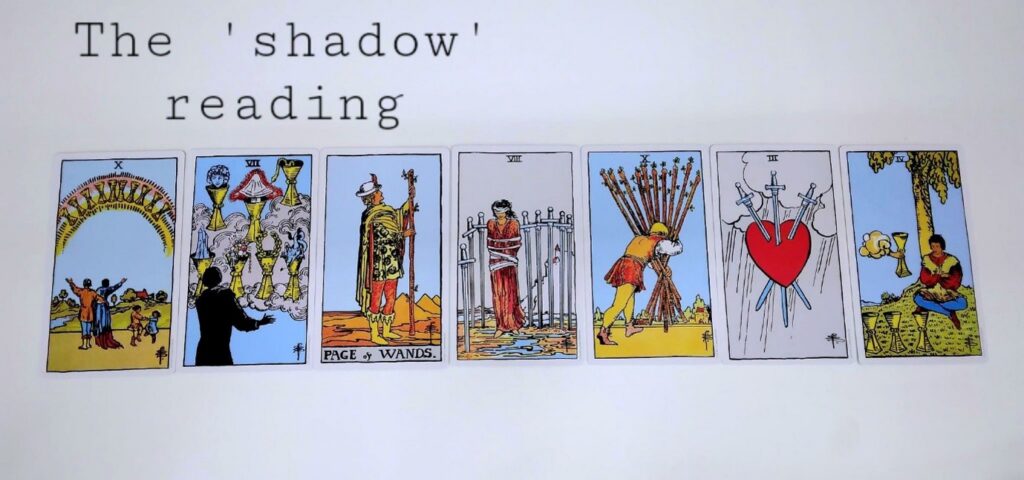
The ‘shadow’ reading – what we don’t want:
Participants always acknowledge how interesting and even difficult it is to choose between their three cards: one to keep (see above), one to return / recycle back into the deck (possibly to be chosen again), and one to remove from the game. Arguably, this dilemma is the crux of the game. The shadow reading therefore isn’t necessarily a story of what we wholesale ‘reject’, but simply a consequence of the other two choices.
Nonetheless, a narrative here could be: a story has completed (Ten of Cups) – are we done with wishful thinking, notions of certainty or happily-ever-after (ouch)? Has the picture changed so greatly that what motivates us also has to change? Without this former story to set the frame, we’re faced with uncertainty, confusion, indecision (Seven of Cups) – an array of seemingly fantastical options; risky, illusive and ungrounded. There’s a sequence here, where ideas about building or growing (Page of Wands) keep leading to disempowerment or the feeling of being trapped by our own decisions (Eight of Swords), which makes the endeavour feel harder than it needs to be (Ten of Wands), ultimately leading to upset (Three of Swords). No wonder we’re left with feelings of disappointment or ennui (Four of Cups). *Pro tip: at this point, jump back to the Page of Cups in the chosen reading, you can pick up the story from there…
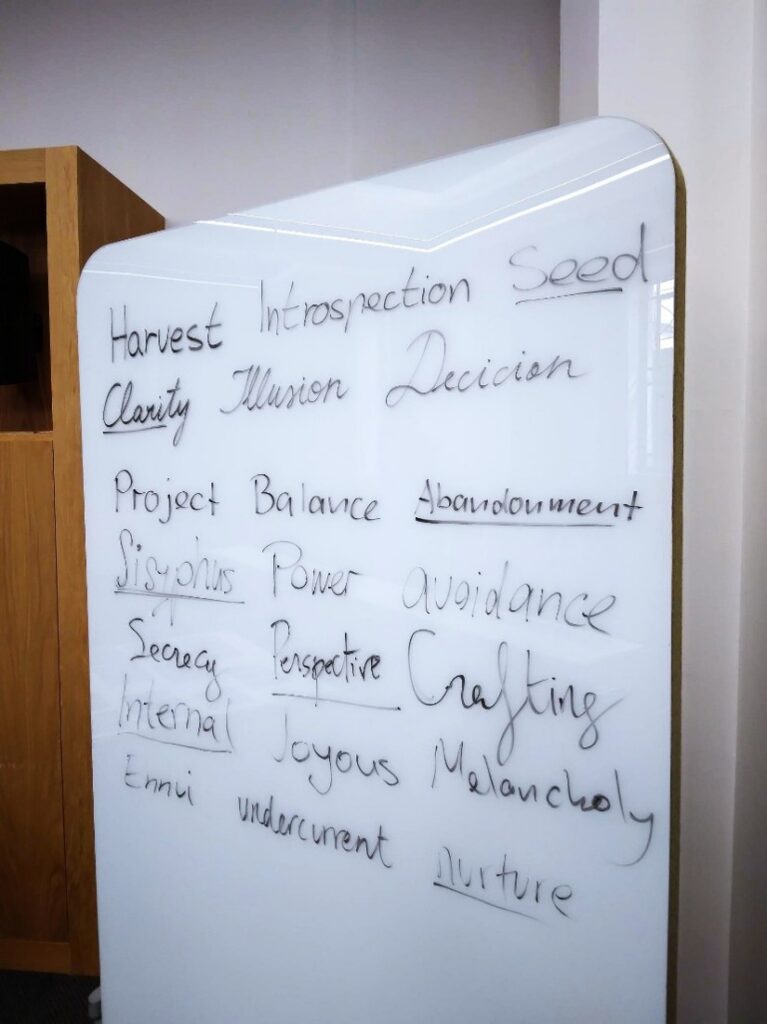
The Poem:
Participants assigned a word for each of their three cards, drawing from accepted card meanings and discussion but moreover, an entirely personal response. Strung together, they make a collective list poem:
Harvest introspection seed
Clarity illusion decision
Project balance abandonment
Sisyphus power avoidance
Secrecy perspective crafting
Internal joyous melancholy
Ennui undercurrent nurture
And of those, the words for the cards kept for the chosen reading (underlined in the image) give us a distilled list:
Seed clarity abandonment
Sisyphus perspective
internal nurture
A couple of things we noticed on the day – the Moon card appeared twice and being a Major Arcana, it carries slightly more weight. It seems there’s a call to consider dreams and fears, the subconscious, hidden or shadowy things, messages that at first seem unwelcome but can actually show a way through. And we met three out of the four possible Pages (Wands, Cups and Pentacles – absent was the Page of Swords) – arguably apt for the setting, being the card of the student, seeker, messenger, researcher, the curious mind. Interestingly, the one Page that would be most ‘of the mind’ is the one we didn’t see (Swords) – but having spent so much of the conference amidst ‘heady’ things, perhaps GTC offered a space to explore in other ways. Everyone in the room was already the Page of Swords.
With thanks to participants for their contributions and fantastic discussions, and to the CEE for hosting and supporting this way of working – and playing – together.
