



By Sean Field
On 15 March of this year, just a few weeks ago, the UK’s Secretary of State for Energy and Climate Change, Ed Miliband, said:
Global events demonstrate there’s not a moment to waste in our drive for clean power because there can be no energy security while we are so dependent on fossil fuels.
Everything we are doing is about one purpose: fighting in the corner of the British people by taking back control of our energy.
Like other places, the UK is in the midst of an energy transition – defined by a move toward renewable sources of energy and the electrification of energy systems as the country phases out – or at least reduces dependence on – fossil fuels. The ending of coal electricity generation in 2024 and record levels of solar and wind generation are notable milestones along this trajectory of the UK Government’s legislative and policy pathway.
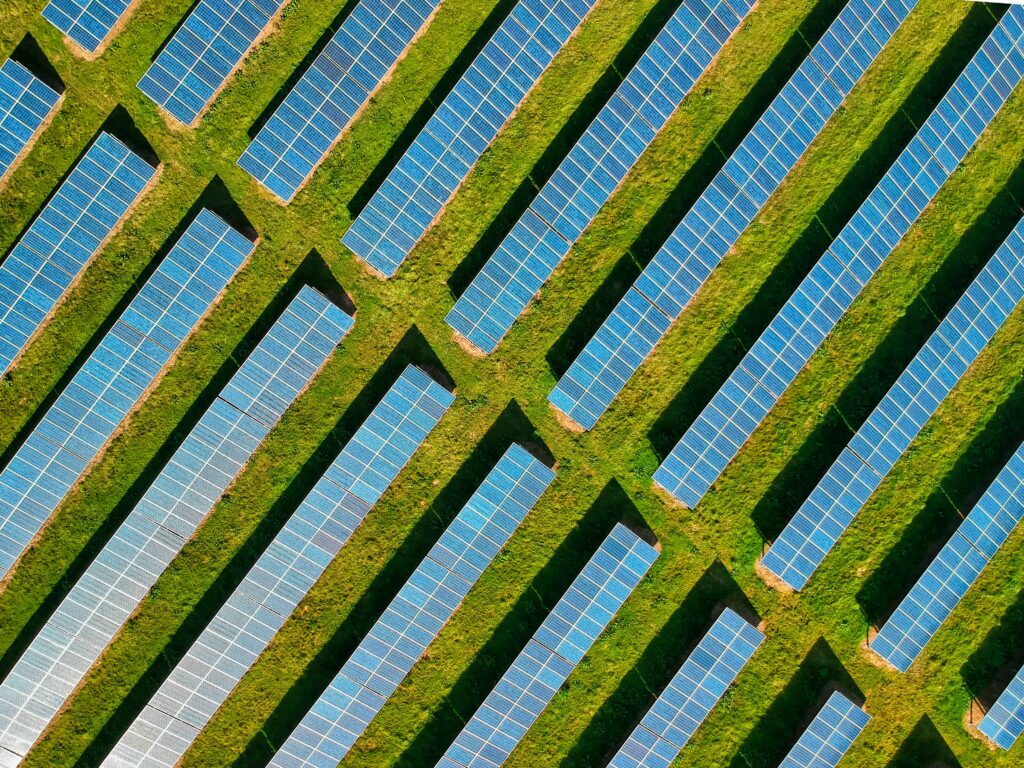
Image courtesy of Red Zeppelin.
This transition pathway, however, has been fraught with political tensions. Tensions associated with the rising cost of energy, visions of future prosperity, and moral claims about the ‘rightness’ or ‘wrongness’ of pursuing net zero. There are countless media examples of how these tensions have featured in popular public discourse.
Geopolitical tensions with Russia, a major supplier of natural gas, and the US-Isreal war with Iran in the Middle East, have sharpened these tensions and polarised popular and policy debates on energy and climate policy. In particular, they have shifted popular and policy discussions to focus on energy security.
The desire for greater energy security, on the one hand, has instigated calls for a faster transition to ‘home grown’ renewable sources of energy, as echoed by Miliband. An argument that posits that energy transition and security can and should be mutually-reinforcing.
On the other, they have instigated calls for new and expansive forms of fossil fuel extraction in places such as the North Sea – an argument that aims to secure the UK’s long term supply of oil and gas.
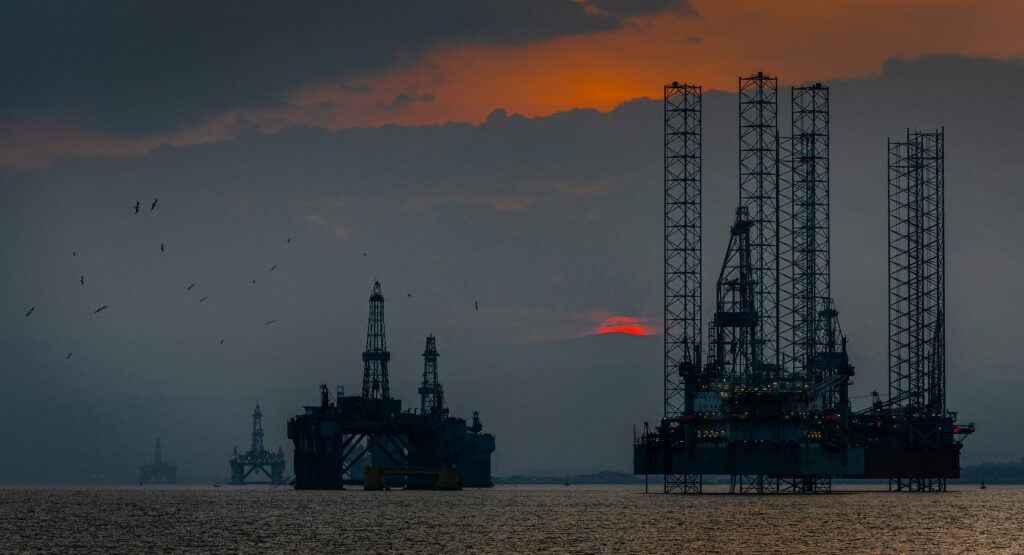
Image courtesy of Ben Wicks,
In this short two-part series, I examine how the UK has grappled with competing demands for energy security and decarbonisation. Balancing these demands has not been easy. And, I argue, have been shaped by the ‘technoeconomics’ of valuing energy security1.
Valuing Energy Security
The UK Government defines energy security has having three overlapping pillars: 1) Economic accessibility, hinged on the relative price of energy and the ability of people and businesses to afford it. 2) The physical availability of supplies to meet demand. 3) The resiliency of the energy system to disruption2.
Observers of UK energy policy will have noticed a shift in the government’s energy policy priorities in recent years – expanding its mandate to emphasis not just climate change abatement but also security. The policy problem of energy security is that it is not easily or readily valued within the appraisal framework of the Green Book.
The Green Book is the technoeconomic ‘play book’ by which proposed and existing policy should be appraised. It takes, as its starting point, neoclassical economic theory about how markets should ideally work, and how, through markets, social values are formalised as exchange values via processes of exchange.

Technoeconomics entails combining scientific and economic analytical techniques, and it underpins corporate and governmental decision-making about energy production, climate change, infrastructural investment, and policies associated with energy transitions (if interested in further discussions of technoeconomics see the work of Canay Ӧzden-Schilling and Kean Birch on this). Integrating engineering estimations with climate modelling and economic forecasting, this form of analysis informs judgements about what is good, what has worth, the futures worth working toward, and who benefits.
The policy problem of energy security is that it is not easily or readily valued within the appraisal framework of the Green Book. First, the Green Book makes a base assumption about the efficacy of open and free markets – simultaneously as a morally correct idealisation; as a (Micheal) Callion description of reality; and, as something worth striving for. This has led to a lack of attention to how markets actually function, and could function, especially when geopolitics leads to a divergence from this idealisation.
Second, for methodological valuation reasons – questions of availability and resiliency are almost always reduced to questions of accessibility. That is, reduced to questions of price, which provide a very narrow framework in which to consider the impacts of when risks and uncertainties become realities. For example, one of the primary ways that energy security is appraised is through a methodology called Value of Lost Load, which assesses how much people and institutions would be willing to pay not to lose power. But this supposes there are supplies to be bought, and it supposes that people and institutions have the ability to buy them. Both of these assumptions have, over the last few years, been called into question.
Because of the appraisal framework set out in the Green Book, which is rooted in neoclassical economics, energy security has not only been undervalued, it has been largely left – de facto -to ‘the market’ to provide. Market actors, however, are not responsible, or incentivized, to provide the UK with energy security, at least within the UK’s present policy programme. In neoclassical economic terms energy security is a ‘positive externality’ – it’s good for society and the economy, but it is not reflected in market prices and is therefore not something energy suppliers are concerned with providing.
Energy Insecurity in the UK
The way that energy security is appraised (i.e. valued) has, thus, contributed to why the UK finds itself in an energy security predicament. The UK has, and continues, to invest in renewable energy production, which will reduce its emissions and bolster its energy security by increasing the energy it produces domestically. Currently, however, renewable sources constitute a relatively small proportion of the UK’s overall energy mix. In 2025, for example, total UK energy production was at a record low, 68% lower than in 1999 when UK production peaked (see Figure 1). Wind, solar, and hydro production are the smallest portion at the top of the bars between 2010-2025 in Figure 1.
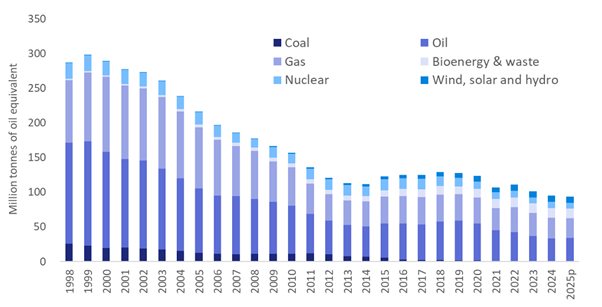
Source: DUKES. 2026. Energy Trends.
In 2025, fossil fuels accounted for 75.2% of the UK’s total energy mix, and the UK’s total net energy import dependency was 43.5%. The implication is that the UK remains dependent on imports to make available the energy supplies needed to meet domestic demand.
The UK’s Thatcher-era assumption3 that ‘the market’ – including international trade – would make available the energy supplies it needed ‘worked’, until major geopolitical events – the wars in Ukraine and the Middle East – disrupted global energy supply chains and called this assumption into question.
So, what is the prospectus for this predicament? And how is the UK Government responding? I explore the answers to these questions in Part 2.
Notes:
1) This article based on a lecture delivered at the University of Lapland on 20 April 2026.
2) Sean was a Lead Analyst in the UK’s Department for Energy Security and Net Zero from 2024 to 2026, where he provided strategic analytical advice on issues of policy and energy security.
3) For more on the transformation of the UK’s energy system, see for example: Natural gas in the UK, part 1: infrastructures & geopolitics and Oil, Oil, Who wants some oil? Part 4: The Brent Crude Complex.