


I never stop enjoying the fact that the etymological root of the word radical is the Latin radicalis: of the roots, regarding roots; from radix, meaning root. A large part of my practice as a writer is rooted in my interest in grassroots creative practice; in the power of the imagination – once freed and encouraged and given helpful containers (no one-size-fits-all) – to create change and navigate times of challenge or upheaval. One individual dreaming in their studio or living room is great, but when we radiate and reach each other, so much for the better.
In January 2024, I launched Off the Rails Writing Group — an ongoing, taught writing group held at Off the Rails Arthouse in Ladybank, Fife. Following my tenure as Artist-in-Residence with the CEE in 2022-2024, through which I produced my poetry collection Long Field Loop (Tapsalteerie 2024), I was delighted when the CEE agreed to sponsor two subsidised places for the writing group; an arrangement which continued into this, currently our third year.
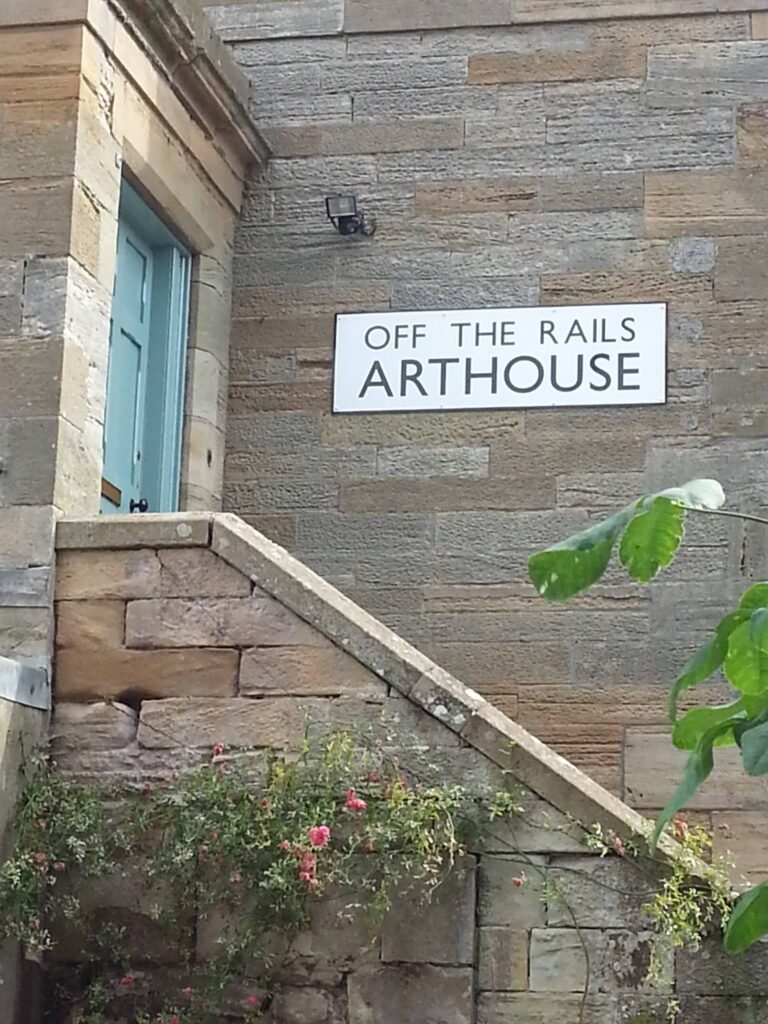
The group is named after our venue – established in 2011 and now a volunteer-run registered charity, local artists renovated the Victorian B-listed former Station House to use as a creative workspace before opening the doors to host a range of art activities.
Ladybank is still an active station, handy for accessing the Arthouse by train. I sense there’s something helpfully non-threatening about coming to a creative writing group held at a predominantly visual arts venue; a reassuringly practical and well-used space with paint marks on the tables and an allotment outside. And the poetry of being at a train station: each on our own journey, but meeting somewhere along the way.
Our adopted moniker has come to mean a great deal to us. We see the group now almost as a sort of renegade MLitt ‘course’ (though I avoid that word myself). For some, the group has represented a return to structured learning and creative practice after time away due to a range of factors and life events. For others, it’s been a way of accessing something from which they were or felt previously excluded or discouraged. And for some, it’s purely for the joy of it – the social aspects, the right amount of challenge, and just seeing what comes of it all. After Emily Dickinson, we’re telling it slant; embracing paths that may not have been obvious, easy or direct, but are all the richer for it.
You can find examples of some of the work produced and testimonies from writing group participants in the Writing Group Showcase post which accompanies this piece.
HOLISTIC CREATIVE PRACTICE
I’ve taught creative writing (mostly poetry) independently in workshop settings for the best part of twenty years, alongside my own writing practice. Over the past decade, I’ve also been refining what I think of as holistic creative practice – less compartmentalisation of my professional and personal interests and activities – as well as forever seeking sustainable models for freelance working. These days, I’m only interested in doing something if it’s equitable and sustainable for myself and others.
This seed was sown in my early career training and freelance work with the Windows Project in Liverpool, from around 2008 when I joined their Writers Attachments Scheme (training writers in workshop design and delivery with a range of participants in community and educational settings), to when I moved back to Scotland in 2014. Founded in 1976 by writers Dave Ward and Dave Calder, having survived decades of funding precarity, the Windows Project has supported writers and grassroots creative practice for over fifty years and continues to deliver community writing activities across Liverpool City and Merseyside.
I havealso taught at universities. Most recently (as a freelancer) the Honours modules Writing Poetry and Writing the Environment for the University of Dundee (English and Creative Writing) in 2024-2025; as well as occasional guest workshops elsewhere at Undergraduate and Masters Creative Writing level, and with the CEE.
I love devising themes and formats for my teaching — very often drawing from what I’m reading, writing, noticing and thinking about in my own work at the time. This is where it sings, for me: for the most part, nothing is separate. I feel first-hand the value of sharing our creative explorations and responding to the world together, in real time. Together, we find what works and what doesn’t. We adjust, fill in the gaps; and have the courage to make stuff up.
SUSTAINABLE STRUCTURE
There’s a tarot card I love, the Four of Wands. It shows four wooden poles (wands) erected to make a gazebo-like frame, which is garlanded with flowers. Through it, we can see buildings in the distance, with people waving and cheering, urging us to step through the frame and join them. The meaning is around harmony, celebration, gathering and fruitful endeavour; growth and creativity through structure. Having a great idea is one thing, but getting your energy and resources in order can be quite another. If you do this however, you stand a good chance of finding other people who want the same, and collaboration can grow from there. Once you have the model in place, the energy has somewhere to go, and you won’t have to rebuild the structure every time.

Before establishing the group, I would typically hold around three independent, usually full-day workshops in a year. As much as I enjoyed it, the format was unsustainable. The preparation required to create content for a full day’s activity, plus all the practical planning, marketing and administration, meant that one day of delivery equated to several days of unpaid work. To account for this and make it a viable source of income, the cost to participants needed to be set fairly (yet appropriately) high, which would inevitably put it out of reach for some. We would have a fantastic and enriching day together, then in most cases would never see each other again. And repeat; with each event starting again from scratch.
I was able to test many ideas and amass a wealth of material. I didn’t want to lose this way of working, but it needed to change. In answer, I came up with criteria for a taught writing group – one that:
- meets regularly in a term-like pattern, with breaks;
- can support continuous and in-and-out participation, as well as being open to newcomers: commitment with flexibility;
- is sustainably affordable to participants, in terms of both cost and time/attention;
- has lower overhead costs per-session for me, supporting long-term function;
- requires less preparation and admin by me per-session (compared to a one-off workshop);
- fosters meaningful and lasting creative community;
- supports local economy and grassroots initiative;
- meets people where they are;
- is more than the sum of its parts.
Off the Rails Writing Group was born. I run it in three Blocks per year (roughly Jan-March; April-June; Oct-Dec); each Block containing five fortnightly sessions, each one three hours long (midweek 6-9pm). Commitment is to one Block at a time (ie. no cherry-picking individual sessions). Capped at around 10 participants due to the size of the room and the quality of individual attention I want to give, we were fully-booked from the outset. Numbers have varied from 6 at the lowest (which I can accommodate when I know folk are planning to return in a subsequent Block), to 12, and has now settled at a steady 9 or 10. Some writers have been attending since the start without a break; others have come since the start but with occasional breaks; and each Block has included 1 to 4 newcomers.
Participants have been aged from 30s to 60+. Some are visual artists with various levels of formality. Some are practicing writers, from casual to focused – with interests spanning poetry, performance, fiction and memoir. Some have had very little formal writing experience. Most have had other careers. Some have completed MA / MLitt level courses in writing, visual art and other fields; some to PhD.
Each session comprises some taught content (a form or theme), which I’ll have distilled into a bespoke writing exercise; writing time, individual feedback and group discussion. Sometimes a session will produce written work in real time, and/or it will be more about creative note-taking and experimentation to feed into further work. In all cases, I advise writers to let the session percolate: it might lead to a finished piece, it might not. It might provoke us in unexpected ways.
In every Block I aim to offer a varied menu of formal/technical and looser, more conceptual sessions. Across the first 2 years – 6 Blocks, 30 individual sessions in total – the techniques and subjects we covered include braiding and polyphony; ekphrasis; concrete and visual poetry; literary maps; cinquains, nonets, haiku and haibun; creative non-fiction; prose poetry; place, memory and the Poetics of Space; point of view, perspective and voice; playwriting; editing; interdisciplinary and multisensory work; contrapuntal and palindromic poetry; the uses of myth; song lyrics; the sonnet; the ghazal; the Bop; the pantoum; the Golden Shovel; etymology; renga and collaborative writing; and Visual Vernacular and BSL, with our first guest presenter Lisa Li.
I’ve encouraged the writers to develop pieces for submission to magazines and competitions – though I always stress that this doesn’t have to be the goal for everyone. If nothing else, it can be useful to have a deadline. Joyfully, this has led to first-time publication and competition success for some of the writers; and ongoing success for others. A number of the writers are now developing their own first poetry collections.
I am constantly in awe of group members’ ‘other’ achievements (though as I hope we’ve established by now, we aren’t all that interested in compartmentalising…): exhibitions and awards with the Royal Scottish Academy and the Society of Scottish Artists; events with StAnza poetry festival and Edinburgh International Book Festival; national and international accolades for independent film-making; consultation in decolonisation practices; songwriting; supporting children, family members and others through various stages of life; exploring career changes; recognising a personal upshift in confidence and skills; and a range of other creative outputs and collaborations.
We have a lively WhatsApp group where conversations can spill-over between sessions (participant-led). A goal I’d like us to realise at some point, is to create a group anthology. I would produce this through my own imprint Souterrain Press (another example of holistic creative practice in action: an indie press I reserve for niche projects) – though we’re open to offers if any small press editors are reading and feel like joining the party…
SONNETS BY STEALTH
American poet and educator Diane Seuss gave the annual Kenneth Allott/Poetry Society Annual Lecture in November 2025. A soul-level favourite of mine, she has since been adopted as something of an unofficial group mascot. Seuss’s collection frank: sonnets (Graywolf Press) won the 2022 Pulitzer Prize for Poetry, described by the prize committee as “a virtuosic collection that inventively expands the sonnet form to confront the messy contradictions of contemporary America, including the beauty and the difficulty of working-class life in the Rust Belt.”
In the lecture, Seuss stated: “I did not write a book of sonnets about my life to beg for legitimacy. Rather, I wanted to co-opt a form that seemed to belong to the well-bred and academic insider, to re-situate my speaker, and therefore the reader, to the outskirts, an act, as Toni Morrison and bell hooks would describe, of re-centering the center.”
In previous years, when opening a workshop, I would occasionally joke (no doubt unfairly) ‘don’t worry, we aren’t doing sonnets’ – solely with the intention of easing anyone’s nerves. It takes guts to go to a poetry workshop. But I recognised there was some good work of reclamation that might be done. With Off the Rails, last year I included my ‘sonnets by stealth’ exercise (in a nutshell, less scary if you don’t know you’re writing one); and we have explored expanded ‘sonnet-ish’ forms – what Seuss refers to in her own work as ‘freaking form’, “learning traditional forms so that they can be usurped, upended, repurposed” (The Rumpus) – such as the Bop from Afaa Michael Weaver, and Jericho Brown’s duplex.
Earlier this year, I was able to include a full sonnets class, with no hiding. We explored this traditional (and traditionally white European) form through its cultural historical context, and in the work of contemporary writers such as Seuss, Terrance Hayes and Wanda Coleman, and others. Sidenote: you might have spotted that every poet I’ve referenced has been American. This is purely coincidental; at most a sign of my taste and recent reading habits. In sessions, we’ve looked at the work of many writers, as well as drawing widely from visual art, music, science, mythology and nature.
There is so much we can do. As we approach our summer break in June 2026, we’re already looking ahead to when we can resume in the autumn. With thanks to participants of the group past, present and ongoing for all helping to keep our wands upright and garlanded; to the Arthouse for being such a genial host; and to the CEE for recognising the value of this work, making it that bit easier at the start for everyone to step through and join in.