

by Joan Sullivan
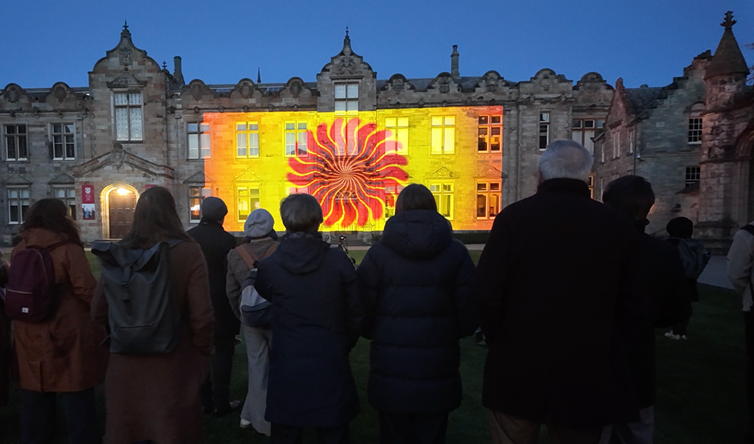
My six-month artist-in-residency with the Centre for Energy Ethics was spread out over one year, from March 2025 to March 2026. During this period, I conducted creative research in both Canada and Scotland, culminating with a public presentation of my first architectural projection – I BURN SO YOU DON’T HAVE TO (embedded below) – a 10-minute video-poem that gives voice to the Sun.
This ephemeral artwork was projected onto the outer wall of Lower College Hall’s School 6 in the St Salvator’s quadrangle, 13-14 March 2026. This projection was a collaboration between CEE and the StAnza International Poetry Festival. A poet from Northern Ireland, Rachel McCrum, interpreted the voice of the Sun during this live event.
For the CEE residency, I challenged myself to create a new artwork about the energy transition that did not focus on energy technology (solar panels, wind turbines, EVs, battery storage, etc). Instead, a quote from the French philosopher, Georges Bataille, inspired me explore our relationship with the Sun, the source of all light and energy – including fossil fuels, a.k.a. fossilized sunlight – that we need to thrive on planet Earth:
“The origin and essence of our wealth are given in the radiation of the sun, which dispenses energy – wealth – without any return. The sun gives without ever receiving.”
With its interdisciplinary approach, the Centre for Energy Ethics is an excellent place for self-directed artists to think about the energy transition in myriad ways. In addition to visiting scientists in their research laboratories, I was able to spend time with philosophers, anthropologists, geographers, economists, poets and musicians. I sat in on several lectures. Throughout my residency, I tried to meet as many CEE-affiliated faculty members as possible to inform my research. I also spent a lot of time reading, writing and reflecting in the university’s main library. In the end, it was a combination of poetry (Walt Whitman) and Indigenous philosophy that most influenced my creative research, by giving voice/agency to the more-than-human, in this case, the Sun.
Soon after my first visit to St Andrews, my project began to coalesce around one central question: If the Sun does indeed have agency, what might he tell us Earthlings, if only we would listen, about our addiction to fossil fuels? After all, we once idolised the Sun, sacrificed virgins to him, named kings after him, and used solar energy (in the form of wood) to fuel the voracious appetites of the many fire-based industries (Copper, Bronze and Iron age smelters and foundries) throughout the millennia.
With a huge dose of artistic license, I began to imagine the Sun as a scorned lover (!), completely baffled at Homo sapiens’ preference (since the mid-1800s) to extract energy from underground rather than harvesting the Sun’s free and infinite electrons. In the poem that accompanies my video, the Sun declares he will take us back if we ever choose to recognize the folly of gazing into the bowels of the Earth:
Come back to me. Pause
In this moment, take
Another path before the
Dark Ages swallow you again.
Raise your face from the bowels of the Earth.
I ask for nothing.
My children, I burn so you don’t have to.
I hope that those who saw my video-poem, I BURN SO YOU DON’T HAVE TO, in the St Salvator’s quadrangle at the end of my CEE residency will be motivated to fundamentally redefine our relationship to the Sun. We are still “living in the Dark Ages” by ignoring the most obvious heliocentric fact: that the Sun, at the center of our solar system, should also be at the center of our energy strategies.
